


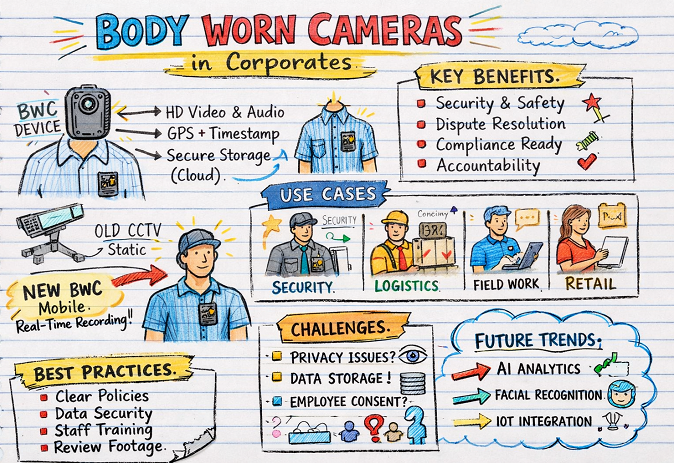
In an era of heightened scrutiny and demands for greater transparency, a new piece of technology has become a central and often controversial part of modern law enforcement and public-facing professions. This is the domain of the global Body-Worn Camera industry, a rapidly growing sector focused on the development, manufacturing, and management of rugged, wearable cameras designed to record interactions between officials and the public. Primarily associated with police officers, these devices are increasingly being adopted by a wide range of other professionals, including private security guards, corrections officers, emergency medical technicians, and even retail employees. The fundamental purpose of the body-worn camera (BWC) is to create an objective, audio-visual record of events as they unfold. This record serves multiple crucial functions: it can be used as evidence in criminal proceedings, serve as a tool for de-escalating tense situations, help to resolve civilian complaints, and provide invaluable material for training and performance review, making it a powerful and transformative technology in the pursuit of accountability and trust.
The ecosystem of the body-worn camera industry is a highly integrated system that extends far beyond the camera hardware itself. At the forefront are the hardware manufacturers, which include specialized public safety technology companies as well as broader electronics firms. They are responsible for designing and building the rugged, durable cameras that can withstand the rigors of field use, featuring capabilities like high-definition recording, wide-angle lenses, low-light performance, and long battery life. However, the hardware is just the tip of the iceberg. A critical and increasingly dominant part of the ecosystem is the software and data management component. This includes the cloud-based or on-premise platforms used to securely store, manage, and catalog the massive volume of video footage generated by the cameras. These platforms provide tools for redacting sensitive information, tagging videos with metadata (such as case numbers), and maintaining a secure chain of custody for evidentiary purposes. A host of other players, including IT service providers, legal and policy consultants, and data storage specialists, also form a crucial part of this complex ecosystem.
The core functionality of the BWC industry revolves around the entire lifecycle of a video recording, a process often referred to as "digital evidence management." This lifecycle begins with the recording itself. Modern cameras often feature pre-event buffering, which continuously records a loop of video (typically 30-60 seconds) even before the officer presses the record button, ensuring that the moments leading up to an incident are captured. Once a recording is stopped, the camera is docked at the end of a shift, and the video files are automatically and securely uploaded to the central storage system. It is at this stage that the powerful software platforms take over. They automatically categorize the footage based on officer ID, date, and time. The platform's software allows authorized personnel, such as supervisors or prosecutors, to search for, view, and manage the video. A crucial function is redaction; the software provides tools to blur faces of minors or bystanders and mute audio to protect privacy before a video is released to the public or used in court, a legally essential and time-consuming task that modern software helps to automate.
The primary drivers behind the explosive growth of the BWC industry are complex and multifaceted, stemming from powerful societal and political pressures. The most significant driver has been the global demand for increased police accountability and transparency in the wake of a series of high-profile, controversial incidents between law enforcement and civilians. Public protests and media scrutiny have put immense pressure on police departments to adopt BWCs as a means to build community trust and provide an objective record of encounters. This has been strongly supported by many government bodies, which have often provided grants and funding to subsidize the purchase of these systems. From the perspective of law enforcement agencies themselves, BWCs are also seen as a valuable tool. They can protect officers from false accusations, provide clear evidence to support arrests and prosecutions, and have been shown in some studies to lead to a reduction in both use-of-force incidents and citizen complaints, creating a compelling case for adoption from both sides of the accountability debate.
Explore More Like This in Our Regional Reports:

 English
 Arabic
 French
 Spanish
 Portuguese
 Deutsch
 Turkish
 Dutch
Dutch
 Italiano
 Russian
 Romaian
 Portuguese (Brazil)